

The monthly price of a dedicated server is the easiest number in the budget to find and often the smallest one that matters. A business that moves a busy store or application onto its own hardware usually budgets carefully for the server lease. It is the costs around the lease that tend to be missing:
- the control panel licence
- the backups
- the hours someone spends patching and monitoring the machine
- the migration in and, eventually, out
- the risk of relying on a single physical server
Over three years, those costs routinely add up to several times the lease itself.
This guide explains the total cost of ownership (TCO) of a dedicated server in Canada. It covers what a server costs to rent in 2026 and the costs businesses most often forget. It then gives a three-year worksheet you can fill in with your own figures, and a worked example that shows how the numbers usually fall. It also explains when dedicated hosting in Canada is the economical choice and when a VPS or cloud setup would cost less.
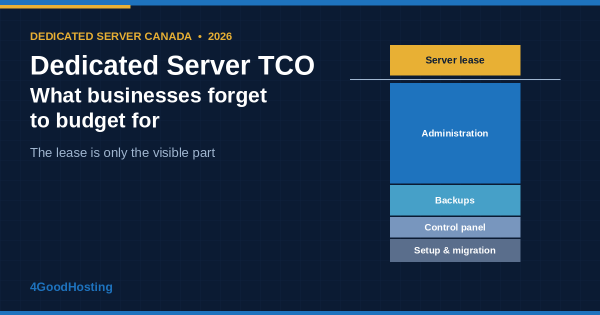
Graphic showing a dedicated server lease above the line and administration, backups, control panel and migration costs below it
Dedicated server Canada pricing versus total cost of ownership
| Term | What it includes |
| Server price | The monthly lease for the hardware, network port and rack space |
| Platform cost | Everything needed to run the server as a business system: control panel, operating system licences, backups, security add-ons, extra IP addresses, monitoring |
| People cost | The time spent managing the server, paid either to the provider (managed hosting) or to your own staff or contractors (unmanaged) |
| Lifecycle cost | One-time costs at the start and end: setup, migration in, hardware changes, migration out and data wiping |
| Risk cost | The expected cost of downtime and the price of reducing it, such as a second server for failover |
TCO is the sum of all five over the period you expect to use the server. Three years is a practical horizon, because it matches common contract terms and the point at which many businesses reconsider their hardware.
What a dedicated server in Canada costs to rent in 2026
Lease prices depend on processor, memory, storage and network. As a reference point, here are the entry configurations 4GoodHosting publishes for its Canadian dedicated servers, as of 30 September 2026:
| Processor | Memory | Storage | Bandwidth | Monthly price |
| Intel Xeon E3-1230v3, 4 cores | 32 GB | 480 GB SSD | Unlimited | $159 |
| AMD Ryzen 5 3600X, 6 cores | 32 GB | 512 GB NVMe | Unlimited | $179 |
| Intel Xeon E5-1650, 6 cores | 64 GB | 480 GB SSD | Unlimited | $259 |
| Intel Xeon Silver 4208, 8 cores | 64 GB | 480 GB SSD | Unlimited | $279 |
| AMD EPYC 7351P, 16 cores | 64 GB | 480 GB SSD | Unlimited | $299 |
| Intel Xeon Gold 6210U, 20 cores | 64 GB | 480 GB SSD | Unlimited | $399 |
Source: 4goodhosting.com/dedicated-server-canada, 30 September 2026. Prices before tax. Management, backups and control panel are quoted separately.
That puts the lease for an entry dedicated server at $1,908 a year, or $5,724 over three years. The rest of this guide is about everything else.
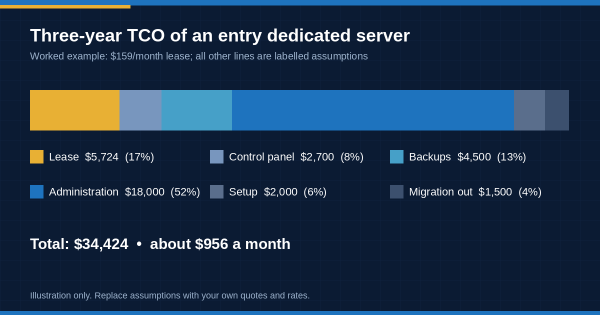
Stacked bar showing that a dedicated server lease makes up about one-sixth of a three-year total cost of ownership in a worked example
The costs businesses forget: platform
Control panel licence. A control panel such as cPanel is licensed per server. cPanel’s own list price for its Premier tier, which covers dedicated servers, was US$69.99 a month for up to 100 accounts as of mid-2026, with a per-account charge above that. Providers resell licences at their own prices, so ask for yours. If you do not need a panel, you avoid the licence but take on more command-line administration, which moves the cost into the people category.
Operating system and software licences. Linux distributions are typically free. Windows Server, SQL Server and some commercial databases carry recurring licence fees, usually billed monthly through the provider.
Backups and disaster recovery. A dedicated server does not back itself up. Off-server backup storage, snapshot retention and periodic restore testing are usually priced per 100 GB or per server. A server with 250 GB of data and 30 days of retention can easily need several hundred gigabytes of backup storage.
Security add-ons. Basic network-level DDoS filtering is commonly included. Higher tiers of filtering, a managed firewall, a web application firewall, malware scanning and intrusion detection are often extra.
Extra IP addresses and monitoring. Additional IPv4 addresses, independent uptime monitoring and log retention are small line items individually, but they recur every month.
The costs businesses forget: people
The largest forgotten cost is time. A dedicated server needs someone to apply operating system and security updates, reboot for kernel patches, and watch disk, memory and certificate expiry. The same person responds to alerts and handles incidents. There are two ways to pay for that:
- Managed dedicated hosting. The provider handles these tasks for a monthly fee. Confirm exactly what is included: operating system patching only, or also the web server, database, control panel and application stack.
- Unmanaged dedicated hosting. Your staff or a contractor handles them. The cost is their time, which is real even when it never appears on an invoice.
A useful way to decide is a break-even calculation. Divide the provider’s monthly management fee by the hourly cost of your own administrator. The result is the number of hours per month at which managed hosting pays for itself. If the fee is $300 a month and your administrator costs $100 an hour, managed hosting is cheaper whenever the server needs more than three hours of attention a month. Most production servers do, once patching, monitoring and the occasional incident are counted.
The costs businesses forget: lifecycle
Setup and migration in. Some providers charge setup fees for custom configurations. Moving an existing site or application onto a new server almost always takes professional time: copying data, testing, cutting over DNS and fixing whatever breaks.
Hardware generation. A dedicated server lease rents a specific machine. The processor generation affects performance per dollar, power efficiency, and how long the hardware continues to receive firmware and security updates. Ask when each processor model was released and what the provider’s replacement policy is. It is often cheaper to lease a newer machine than to add memory or storage to an older one, and the newer machine will stay current for longer.
Contract terms and renewal. Check whether the monthly price is fixed for the term, what happens at renewal, and how much notice is needed to cancel or change hardware.
Migration out and data wiping. Every server is eventually replaced. Budget for the time to move to the next machine or provider, and ask how the provider wipes or destroys drives when a lease ends. Your privacy obligations continue until the data is gone.
The costs businesses forget: risk
A single dedicated server is a single point of failure. If a drive controller or motherboard fails, the site is down until the hardware is repaired or replaced and the data restored. Two numbers help decide how much to spend reducing that risk:
- The cost of an hour of downtime. Multiply revenue per hour at a busy time by the share of it you would lose. Add the cost of staff time and any contractual penalties.
- The cost of redundancy. A second server with replicated data roughly doubles the lease and platform costs, and adds setup and ongoing management time.
If an outage of a few hours would cost less than a year of a second server, good backups and a tested restore plan may be enough. If it would cost more, redundancy is worth pricing seriously.
Compliance adds a further category. A dedicated server that processes card payments brings PCI DSS obligations for the whole environment. A server holding personal information of Québec residents outside Québec requires a privacy impact assessment under section 17 of Québec’s private-sector privacy law. Neither is expensive to handle when planned for, and both are expensive to fix afterwards.
A three-year dedicated server TCO worksheet
Use the worksheet below with your own quotes and rates. Enter monthly costs as monthly amounts and one-time costs once.
| Line item | Type | How to estimate it |
| Server lease | Monthly | Provider’s price for your chosen configuration and term |
| Control panel licence | Monthly | Provider’s quoted price, or zero if not used |
| Operating system and software licences | Monthly | Provider’s quoted price for Windows, SQL Server or other commercial software |
| Backup storage | Monthly | Data size × retention multiplier × provider’s price per 100 GB |
| Security add-ons | Monthly | Firewall, WAF, enhanced DDoS, malware scanning as quoted |
| Extra IPs and monitoring | Monthly | Number of IPs × price, plus monitoring subscription |
| Management | Monthly | Managed fee, or administrator hours per month × hourly cost |
| Setup and migration in | One-time | Provider setup fee plus migration hours × hourly cost |
| Hardware change during the term | One-time | Migration hours if you expect to change hardware |
| Migration out and data wiping | One-time | Migration hours at the end of the term |
| Redundancy (if chosen) | Monthly | Second server lease and platform costs, plus extra management time |
| Downtime reserve | Annual | Expected outage hours × cost per hour |
Add the monthly items, multiply by 36, then add the one-time items and three years of the annual reserve. Divide by 36 to see the true monthly cost.
A worked example: an entry dedicated server over three years
This example shows how the numbers typically fall for an unmanaged entry server hosting a busy online store. The lease is the published price above. Every other figure is an assumption for illustration and should be replaced with your own quotes and rates.
| Line item | Basis | Three-year cost |
| Server lease | $159 a month (published) | $5,724 |
| Control panel licence | $75 a month (assumption) | $2,700 |
| Off-server backups | 250 GB at $50 per 100 GB a month (assumption) | $4,500 |
| Administration | 5 hours a month at $100 an hour (assumption) | $18,000 |
| Setup and migration in | 20 hours at $100 an hour (assumption) | $2,000 |
| Migration out | 15 hours at $100 an hour (assumption) | $1,500 |
| Total cost of ownership | $34,424 | |
| True monthly cost | About $956 |
In this example the server lease is about 17% of the three-year total. Administration time is more than half of it. The result is highly sensitive to the labour assumption:
| Administrator cost per hour | Three-year administration | Three-year TCO | Lease share of TCO |
| $75 | $13,500 | $29,924 | 19% |
| $100 | $18,000 | $34,424 | 17% |
| $150 | $27,000 | $43,424 | 13% |
The example leaves out security add-ons, redundancy, a downtime reserve and any compliance work, all of which would raise the total. It also shows why managed dedicated hosting is often cheaper than it looks. In this example any management fee below about $500 a month would reduce the total, before counting the value of having someone else on call.
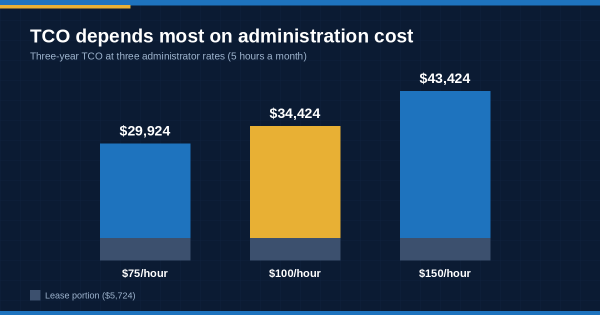
Chart showing three-year dedicated server total cost of ownership at administrator rates of $75, $100 and $150 per hour
Seven ways to lower dedicated server TCO without cutting corners
The worked example shows where the money goes, which also shows where savings are available. None of the options below involves giving up backups or security.
- Automate the routine administration. Unattended security updates, configuration management and automated certificate renewal reduce the hours in the largest cost line. Every hour removed from the monthly routine saves 36 hours over a three-year term.
- Right-size before you sign. Measure your current CPU, memory and storage use at peak, then add headroom for growth. An oversized server costs more in lease and backup storage every month. An undersized one forces an early migration, the most expensive single event in the lifecycle.
- Choose newer hardware when prices are close. A newer processor generation at a slightly higher lease can deliver more performance and a longer supported life. That can defer the next migration.
- Match backup retention to real need. Retention should reflect how long a problem could go unnoticed and what your privacy commitments require, not a default setting. Reducing 90-day retention to 30 days, where appropriate, can cut backup storage substantially.
- Consolidate where it is safe. Several small sites or services on one well-managed server can cost less than several separately licensed VPS plans. The exception is workloads whose security or compliance requirements call for separation.
- Negotiate the term, not just the price. Longer terms may reduce the lease, but check the hardware-change and cancellation terms first. A slightly higher price with the right to upgrade mid-term is often better value.
- Plan the exit at the start. Standard operating systems and control panels, documented configurations and regular off-server backups make the eventual migration faster, which reduces a cost that arrives with every server.
Budgeting mistakes to avoid
A few patterns recur in dedicated server budgets that run over:
- Treating unmanaged as free management. The work still happens. It is just paid for in staff time or not done at all.
- Ignoring currency on licences priced in US dollars. Some software licences are priced in US dollars, so exchange-rate movement changes their cost in Canadian dollars from month to month.
- Leaving out the second year. Migration and setup costs arrive in year one, which makes year one look expensive and years two and three look cheap. Compare providers on the full term.
- Counting the lease as the budget ceiling. In the worked example above, the lease was $159 a month and the true monthly cost was about $956.
- Forgetting the end of the lease. Data wiping, final backups and migration out are real costs, and they fall at the moment the business is least likely to have budgeted for them.
When dedicated hosting in Canada is the economical choice
Dedicated hosting has a higher entry cost than a VPS, but it can have the lower TCO in the right circumstances. When comparing dedicated hosting Canada providers, these are the situations where the numbers usually favour a dedicated server:
- Steady, heavy workloads. A store, database or application that uses most of a server’s capacity all the time gets more performance per dollar from dedicated hardware than from an equivalent set of virtual servers.
- Many sites on one machine. Agencies and multi-brand businesses can consolidate several VPS plans, each with its own panel licence and backups, onto one server.
- Predictable spend. A fixed monthly lease avoids the usage-based charges for data transfer, storage and compute that can make cloud bills vary month to month.
- Isolation requirements. Some security policies or customer contracts require single-tenant hardware.
It is usually not the economical choice when the workload is small or spiky, when nobody is available to manage it and managed service is not budgeted, or when high availability is essential but only one server is funded. In those cases a well-equipped VPS, managed hosting, or a pair of smaller servers may cost less overall.
For the full picture of how costs step up from shared hosting through VPS to dedicated servers, see our guide to [how hosting costs change as a Canadian website grows].
Questions to ask before you choose a Canadian web host for a dedicated server
Most dedicated server Canada quotes cover only the lease, so these questions turn the worksheet into quotes you can compare:
- What is the monthly lease for this configuration, is it fixed for the term, and what happens at renewal?
- When was each processor model released, and what is your hardware replacement policy?
- What does managed service include, operating system only or the full application stack, and what does it cost?
- What do the control panel and any software licences cost per month?
- Where are backups stored, how is storage priced, and are restores free?
- Which security services are included, and which are extra?
- Are there setup fees, and do you help with migration in?
- What happens to the drives when the lease ends, and will you confirm data destruction?
- In which city is the server located, and who operates the facility?
Our guide on how to [choose a Canadian web host] covers the wider due-diligence checks: verifying the company, reading service-level agreements and testing support.
Frequently asked questions
How much does a dedicated server cost in Canada?
Entry dedicated servers in Canada are commonly leased for roughly $150 to $400 a month depending on processor, memory and storage. One Canadian provider publishes configurations from $159 to $399 a month. Management, backups, control panel licences and security add-ons are usually extra, so the total monthly cost of running a dedicated server is typically several times the lease.
What is dedicated server TCO?
Total cost of ownership is the full cost of running a dedicated server over the period you use it. It includes the lease, platform costs such as licences and backups, and people costs for management. It also includes one-time lifecycle costs such as setup and migration, and risk costs such as downtime and redundancy. A three-year horizon is common.
Is managed or unmanaged dedicated hosting cheaper?
It depends on how much administration the server needs and what your own staff or contractors cost. Divide the managed fee by your administrator’s hourly cost to find the break-even hours per month. If the server needs more attention than that, managed hosting is cheaper. Most production servers need several hours a month once patching, monitoring and incidents are included.
What costs do businesses forget when budgeting for a dedicated server?
The most commonly forgotten costs are control panel and software licences, off-server backups, and security add-ons. Administration time, setup and migration are also often missed. So are hardware changes during the term, migration out and data wiping at the end, and the cost of downtime or redundancy on a single server.
When is a dedicated server better value than a VPS?
A dedicated server is usually better value for steady, heavy workloads that use most of a server’s capacity. It also suits businesses consolidating many sites onto one machine, those needing predictable monthly spending, and those with isolation requirements. For small or spiky workloads, or where nobody is available to manage the server, a VPS or managed service often costs less overall.
How do I find the best hosting company in Canada for a dedicated server?
There is no single best provider for every business, because the right choice depends on your workload, your in-house skills and your data-location needs. Compare providers on three-year total cost of ownership rather than lease price. Ask about hardware age, management scope, backup location and pricing, security services, and data destruction at the end of the lease. Choose the one whose written answers hold up best for your situation.
Does a dedicated server keep my data in Canada?
Only if the server, its backups and any management access are all in Canada. Ask the provider which city the server is in, where backups are stored, and where support staff who can access the server are located. For Québec customers, data stored elsewhere in Canada still requires a privacy impact assessment before it leaves Québec.
Key takeaways
- The lease is often the smallest significant cost of a dedicated server. In the worked example it was about 17% of three-year TCO.
- Entry dedicated servers from one Canadian provider are published at $159 to $399 a month, before management, backups and licences.
- The biggest forgotten cost is administration time, whether paid to the provider or to your own staff.
- Use a break-even calculation: managed fee divided by hourly administrator cost gives the hours at which managed hosting pays for itself.
- Budget for platform costs (licences, backups, security), lifecycle costs (setup, migration, data wiping) and risk costs (downtime, redundancy).
- Ask about processor generation and hardware refresh. Newer hardware can lower TCO.
- Dedicated hosting in Canada is most economical for steady, heavy or consolidated workloads with management budgeted.
- Compare providers on three-year TCO using the worksheet, not on monthly lease price.
Conclusion
A dedicated server in Canada is one of the most predictable hosting costs a business can have, provided the budget covers the whole server and not just the machine. The lease is fixed and easy to find. The licences, backups, security, administration, migrations and risk around it are not, and together they usually decide whether dedicated hosting was the right call.
Fill in the worksheet with real quotes before signing. Compare managed and unmanaged on a break-even basis, and ask every provider the same nine questions. That turns a hardware purchase into a business decision you can defend in three years’ time.
Next step
If you would like help building a three-year TCO estimate for a dedicated server, the 4GoodHosting team can provide quotes for management, backups and licences to go with the published server prices. [Talk to the 4GoodHosting team →]