
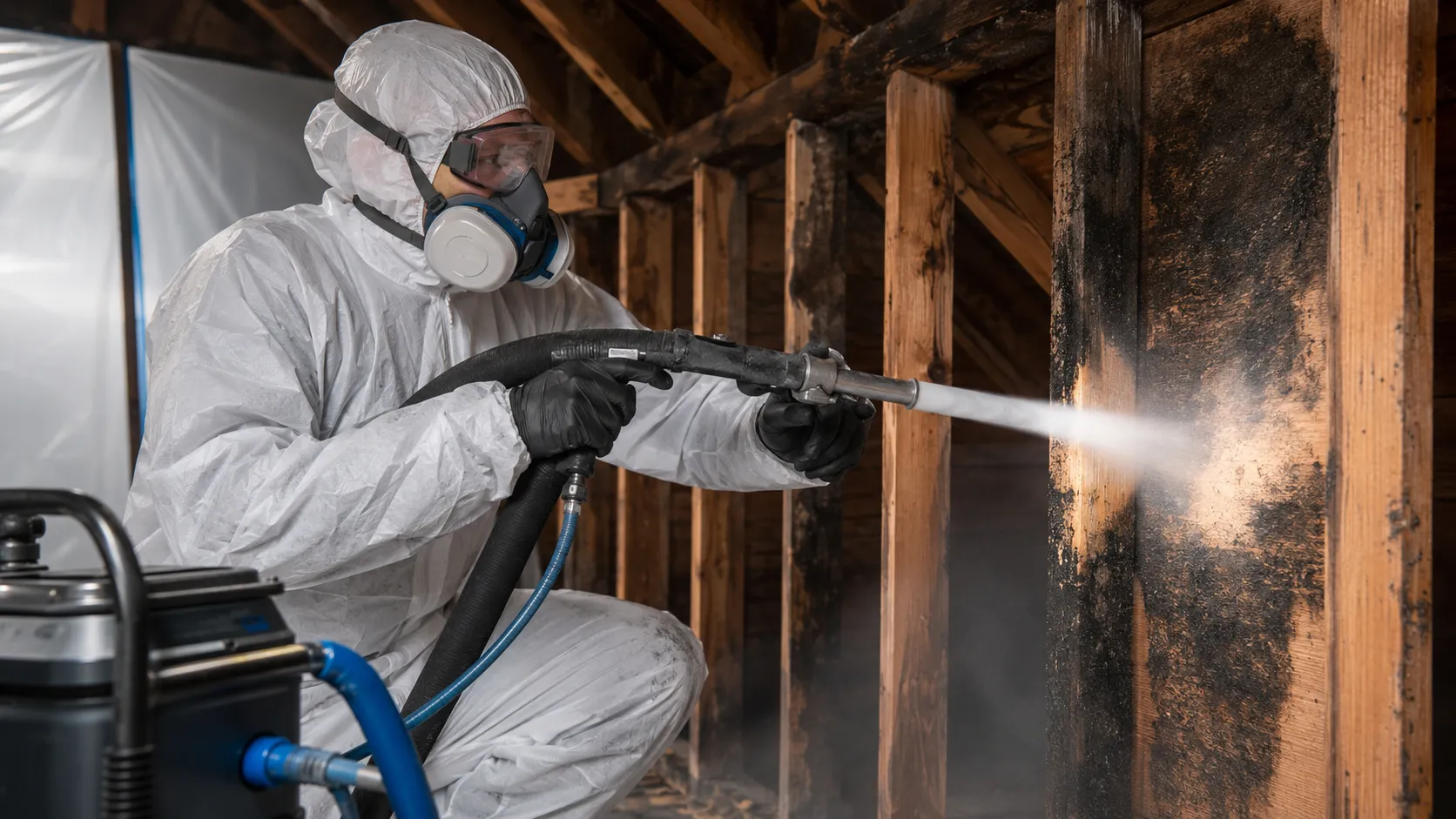
 Property remediation has a built-in dilemma: you need to remove the damage — the mould, the soot, the contamination — without adding new problems in the process. Traditional cleaning methods often do exactly that. Sandblasting gouges the surface underneath and leaves piles of spent grit to dispose of. Chemical cleaning introduces harsh substances and residue. Pressure washing floods an already water-damaged structure with more moisture. Each fix creates its own mess.
Dry ice blasting solves that dilemma in an elegant way, which is why it’s become a go-to method for professional property remediation cleaning across the Lower Mainland. It removes contaminants aggressively yet leaves the underlying surface intact, adds no water or chemicals, and produces almost no secondary waste. But how does dry ice blasting actually work — and why is it so well suited to remediation? This guide breaks down the science in plain language, walks through the process step by step, and explains where it fits in real remediation work.
The short answer: how dry ice blasting works
Dry ice blasting cleans a surface by firing small pellets of solid carbon dioxide (dry ice) at it using compressed air. Three things happen at once on impact: the pellets hit the contaminant with kinetic energy, their extreme cold causes thermal shock that makes the contaminant brittle and loosens its grip, and the dry ice instantly sublimates — turning from solid straight to gas and expanding rapidly — which blasts the loosened contaminant off the surface. Because the dry ice becomes gas and disappears, the only waste left behind is the contaminant itself. That combination is what makes the dry ice cleaning process both powerful and remarkably clean.
Now the detail behind each of those steps.
What is dry ice blasting?
Dry ice blasting — also called dry ice cleaning, CO₂ blasting, or cryogenic cleaning — is a method that uses solid carbon dioxide as a blasting medium to clean surfaces. “Dry ice” is simply carbon dioxide (CO₂) in solid form. It’s extremely cold, at roughly −78.5°C (about −109°F), and it has an unusual property: at normal pressure it doesn’t melt into a liquid. Instead it sublimates, passing directly from a solid to a gas. That single property is the key to the entire process.
In practice, the dry ice is formed into small pellets — hence the term dry ice pellet cleaning — which are fed into a specialized blasting machine and propelled at the surface in a stream of compressed air. Unlike sand, soda, or grit used in traditional abrasive blasting, dry ice is relatively soft and, crucially, doesn’t stay behind after it does its job.
How does dry ice blasting work? The three mechanisms
The cleaning power of dry ice blasting comes from three effects happening simultaneously at the moment each pellet strikes the surface.
1. Kinetic energy (the impact). Accelerated by compressed air, the dry ice pellets hit the contaminant at high velocity. This kinetic impact begins dislodging the material — much like any blasting method. On its own it’s relatively gentle, which is part of why dry ice is non-abrasive to the surface underneath. It’s the combination with the next two effects that makes it effective.
2. Thermal shock (the embrittlement). This is where dry ice blasting differs from ordinary blasting. The pellets are extremely cold, and when they hit the contaminant they cause a sudden, sharp temperature drop at the surface. Most contaminants — paint, coatings, soot, adhesives, biological growth — contract and become brittle when hit with that cold, while the substrate beneath usually reacts differently. That difference breaks the bond between the contaminant and the surface, cracking and loosening the layer so it can be lifted away. This thermal-shock effect is the heart of the cryogenic cleaning process.
3. Sublimation and rapid expansion (the lift-off). The moment the pellet strikes, it sublimates — turning from solid straight to gas. As it does, the carbon dioxide expands dramatically in volume (dry ice is commonly cited as expanding on the order of several hundred times its solid volume as it becomes gas). That rapid, localized expansion acts like a tiny burst of gas beneath the already-loosened contaminant, effectively blasting it off the surface. Then the gas simply dissipates into the air.
Put together, the sequence is: hit it, freeze it brittle, and blow it off — then vanish. No blasting medium is left behind because the dry ice has become gas.
The dry ice cleaning process, step by step
- Assessment and preparation. The area is assessed, the contaminant and substrate identified, and the site prepared — including containment and ventilation where required.
- Setup. The dry ice pellets are loaded into the blasting machine, which is connected to a compressed-air supply.
- Blasting. The technician directs the pellet stream across the affected surface, adjusting pressure and technique to the contaminant and the substrate’s sensitivity.
- Cleaning action. Kinetic impact, thermal shock, and sublimation work together to lift the contaminant.
- Cleanup. Because the CO₂ sublimates into gas, the only material to collect is the removed contaminant that falls away — there’s no spent blasting medium to dispose of.
- Inspection. The cleaned surface is checked to confirm the remediation goal is met.
Why dry ice blasting is ideal for property remediation
The method’s specific properties line up almost perfectly with what remediation needs.
It’s non-abrasive to the substrate. Dry ice is soft enough that, used correctly, it removes the contaminant without gouging or eroding the surface underneath. That matters enormously in remediation, where you often need to clean structural wood, masonry, or delicate materials without damaging them.
It leaves virtually no secondary waste. This is the standout benefit. With sandblasting you’re left with piles of contaminated grit to contain and dispose of. With dry ice blasting, the medium becomes gas and disappears, so the only waste is the contaminant itself — dramatically reducing cleanup, disposal, and the volume of contaminated material to handle.
It’s a dry process. No water is introduced, which is critical in two common remediation scenarios: mould (where added moisture would make things worse) and fire damage in structures already stressed by firefighting water. A dry method cleans without feeding the underlying problem.
It uses no chemicals. There are no solvents or harsh cleaning agents, and no chemical residue left on the surface — a real advantage for environmental and occupant safety.
It can clean in place and reach tight spots. Complex framing, equipment, and awkward cavities can often be cleaned without full disassembly.
Applications in property remediation
Dry ice blasting is used across a range of remediation situations:
- Mould remediation. Removing mould from wood framing, joists, and structural surfaces — dry, without adding moisture, and without gouging the wood.
- Fire, smoke, and soot damage. Stripping soot, char, and smoke residue from structural surfaces after a fire, restoring the material rather than replacing it.
- Water damage restoration. Cleaning affected structural surfaces as part of a dry-out and restoration process.
- Coating, paint, and adhesive removal. Lifting unwanted layers without abrasives or chemicals.
- Delicate and heritage surfaces. Cleaning where a gentler, non-abrasive method is needed to protect the material.
- Post-remediation and detailed cleaning. Final cleaning of surfaces once the primary hazard is addressed.
Dry ice blasting vs. traditional methods
| Factor | Dry Ice Blasting | Sandblasting / Abrasive | Chemical Cleaning | Pressure Washing |
|---|---|---|---|---|
| Abrasive to substrate? | No (non-abrasive) | Yes | No, but residue | Can be, and wets |
| Secondary waste | Minimal (CO₂ becomes gas) | High (spent grit) | Chemical residue/runoff | Water + runoff |
| Adds moisture? | No | No | Sometimes | Yes |
| Uses chemicals? | No | No | Yes | Sometimes |
| Clean in place / tight spots | Yes | Limited | Varies | Limited |
The pattern is clear: for remediation specifically — where protecting the substrate, avoiding added moisture, skipping chemicals, and minimizing contaminated waste all matter — dry ice blasting checks boxes the older methods can’t.
Safety and why it’s a job for professionals
Dry ice blasting is powerful, but it isn’t a DIY method — it carries real safety considerations that require trained operators and proper protocols.
- CO₂ accumulation. As dry ice sublimates it releases carbon dioxide gas, which is heavier than air and can build up in enclosed or low-lying spaces. Adequate ventilation and, where needed, monitoring are essential to prevent a hazardous atmosphere.
- Cold and noise. The medium is extremely cold, and the process is loud, so appropriate PPE — including protection for skin, eyes, and hearing — is required.
- The contaminant being removed. In remediation, what’s coming off the surface may itself be hazardous (mould spores, and in some buildings materials like lead or asbestos). Proper containment, PPE, and — for regulated hazardous materials — the correct abatement procedures and legal protocols must be followed. Dry ice blasting is a tool used within a compliant remediation plan, not a shortcut around one.
A qualified remediation contractor handles all of this as a matter of course, which is exactly why professional property remediation cleaning delivers the method’s benefits safely.
When dry ice blasting is — and isn’t — the right choice
It’s an excellent fit when you need to remove a contaminant from a surface you want to preserve, without adding moisture, chemicals, or piles of secondary waste — mould on framing and soot after a fire being classic examples. It’s less suitable where a surface actually needs abrasive profiling, or where a different remediation approach is required by the nature of the hazard. The right call comes from a professional assessment of the contaminant, the substrate, and the site — not a one-size-fits-all assumption.
Where Urban Environmental fits
For property owners in Vancouver and the Lower Mainland dealing with mould, fire, or contamination damage, this is where an experienced remediation specialist comes in. Urban Environmental uses dry ice blasting as part of its remediation toolkit — removing contaminants while protecting the underlying structure, without the moisture, chemicals, or secondary waste of older methods, and within a fully compliant remediation plan.
Expert tips: choosing a dry ice blasting remediation provider
- Confirm remediation expertise, not just equipment. The method is only as good as the plan around it. Look for a genuine remediation contractor.
- Ask about containment and safety protocols, especially CO₂ ventilation and how they handle hazardous contaminants.
- Verify licensing and WorkSafeBC coverage.
- Get an on-site assessment. The right approach depends on the specific contaminant and substrate.
- Ask whether dry ice blasting is actually the best method for your situation — a trustworthy provider will tell you when it isn’t.
FAQs
How does dry ice blasting work?
It fires pellets of solid carbon dioxide (dry ice) at a surface using compressed air. On impact, three things happen at once: kinetic energy dislodges the contaminant, extreme cold causes thermal shock that makes it brittle and loosens its bond, and the dry ice sublimates into gas and expands rapidly, blasting the contaminant off. The CO₂ becomes gas and disappears, leaving only the removed contaminant as waste.
What is dry ice blasting called?
It’s also known as dry ice cleaning, CO₂ blasting, cryogenic cleaning, and dry ice pellet cleaning. All refer to the same method of using solid carbon dioxide as a blasting medium.
Why is dry ice blasting good for property remediation?
It’s non-abrasive to the surface underneath, adds no water (critical for mould and fire damage), uses no chemicals, and leaves virtually no secondary waste because the dry ice turns to gas. That combination removes contaminants without creating the new problems that sandblasting, chemical cleaning, or pressure washing can cause.
Does dry ice blasting damage the surface being cleaned?
Used correctly, no. Dry ice is relatively soft and non-abrasive, so it removes the contaminant while leaving the substrate intact — which is why it’s used on structural wood, masonry, and delicate surfaces in remediation. Technique is adjusted to the substrate’s sensitivity.
Is dry ice blasting safe?
It’s safe when performed by trained professionals with proper protocols. Key considerations are ventilation (CO₂ gas can accumulate in enclosed spaces), PPE for cold and noise, and correct handling of the contaminant being removed — including proper abatement procedures for any regulated hazardous materials. It’s not a DIY method.
Can dry ice blasting remove mould?
Yes. It’s widely used in mould remediation to remove mould from framing and structural surfaces without adding moisture (which would worsen the problem) and without gouging the wood. It’s applied within a proper mould remediation plan.
Does Urban Environmental offer dry ice blasting in Vancouver?
yes
Key Takeaways
- Dry ice blasting cleans by combining three effects on impact: kinetic energy, thermal shock, and rapid sublimation of the CO₂ pellet.
- Because the dry ice turns to gas, it leaves virtually no secondary waste — only the removed contaminant.
- It’s non-abrasive, dry, and chemical-free, which makes it ideal for remediation of mould, fire/soot damage, and delicate surfaces.
- It protects the substrate while removing the contaminant, unlike sandblasting, chemicals, or pressure washing.
- It’s a professional method requiring proper ventilation, PPE, and — for hazardous materials — compliant abatement protocols.
Conclusion
The reason dry ice blasting has become a mainstay of modern property remediation comes down to a rare combination: it removes tough contaminants aggressively while protecting the surface underneath, and it does so without water, chemicals, or piles of contaminated waste. Understanding how it works — the impact, the freeze, and the burst of subliming gas — makes it clear why it fits remediation so well, whether the job is mould on framing or soot after a fire. Applied by trained professionals within a proper remediation plan, it solves the old dilemma of cleaning up damage without creating new damage in the process.
Dealing with mould, fire, or contamination damage in the Lower Mainland? Request a free assessment from Urban Environmental and find out whether dry ice blasting remediation is the right solution for your property. [Insert Urban Environmental contact link / phone — VERIFY details before publishing.]